

Page 1
Volume 5, Issue No. 8 August 2007
ROADKILL COWBOY VISITS AUGUST SHOOT
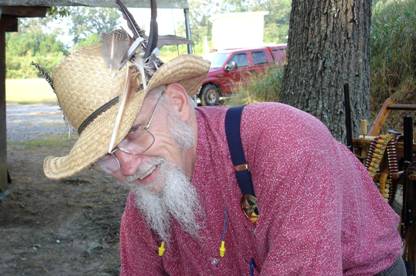
Sundance – the Roadkill Cowboy
Sundance McNeyman showed up for the pre-shoot side-match looking … Well, looking like he’d driven into a herd of chickens on the way to the shoot. And he evidently left a bunch of ‘em in the road, judging from all the different feathers in his summer hat. It appears the chicken drovers took 5 for coffee, and our boy hit the herd … vigorously. At least that’s what it looked like. Then Oracle spouted some words about Cowboy Shooting: “Think about it. Cowboy Shooting is the only man’s sport where a man can walk up to another man, reach out and feel the texture of the material of his vest, and say, “Man, that’s a nice vest.” And nobody will think anything about it.” Both these fellers sound sorta weird. But we’re all a little different: we all go out in public dressed like the folks we pretended to be when we were young’uns playing cowboys and cowgirls.
Then, the shoot began. And Tio Don gave Sundance and Oracle a run for their money in the unusual department. He’d decided to make blue smoke fly when he shot his pistols. So, he put blue stuff in his cartridge cases. But there wasn’t much gunpowder in them cases. So, the blue stuff mixed with the other stuff and the result was sub sonic projectiles going sorta down range, but not more than a few feet. They didn’t even make it to the pistol targets. He ain’t gonna do that again.
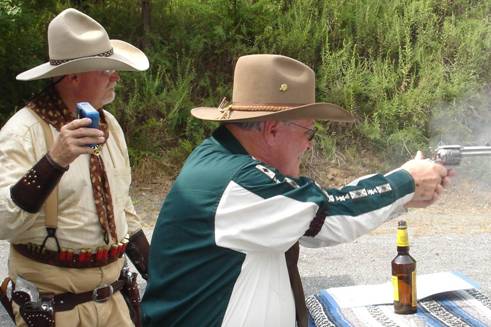
Lightning McCoy times Tio Don as he shoots at bar-flies. He’s Shootin’ real ammo at this point.
Our attendance was down. Several weeks of 90+ degrees temperatures kept lots of folks away. But 48 brave souls, plus Sundance, ventured out to shoot. Ol’ T-Bone did a good job writing the stages. They were fast and not too complicated. Shucks, Tellico even managed to shoot a clean match, as did Lightning McCoy, Josey Buckhorn, Horseshoe John, Wildcat Wilkey and Tennessee Hawk.
S.A. Pondwater was the Top Gun of the day. Last Kiss was the top shootin’ cowgirl. The Top 10 Shooters were: (1) S.A. Pondwater (2) Marshal Too Tall (3) Festus D. Deputy (4) Unpleasant (5) Ocoee Red (6) Widowmaker (7) Dustin Clays (8) T-Bone Angus (9) Pleasant and (10) Fast Harley.
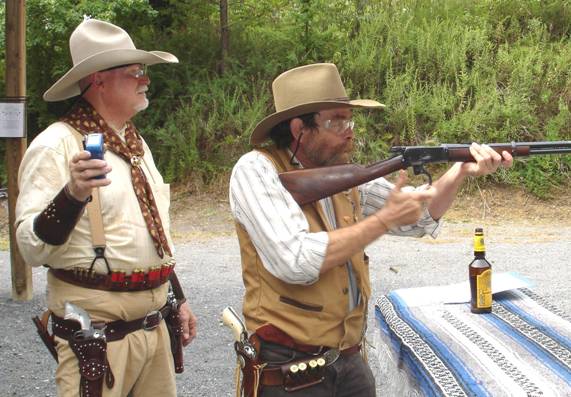
Tellico , shooting, and Lightning McCoy, timing, both shot no-miss matches
Shoot Results – Top Gun .. S.A. Pondwater
Buffalo Shoot – Side Match
o Long Range Single Shot Rifle – Colonel Mortimer o .22 Cal. Lever Action Rifle – Marshal Too Tall o Long Range Pistol – Sundance McNeyman
|
Modern 1. S.A.. Pondwater |
Black Powder Duelist1. Long Gulch |
B-Western1. T-Bone Angus |
Classic1. Lightning McCoy |
Lady Gunfighter1. Last Kiss |
Silver Senior1. Wildcat Wilkey |
Gunfighter1. Widowmaker 2. Pleasant 3. Fast Harley |
49er 1. Marshal Too Tall 2. Festus D. Deputy 3. Ocoee Red |
Outlaw1. Badlands Beck 2. TN Tombstone 3. Rawhide Rex |
Senior1. Purly 2. Deadman 3. Tin Pot |
Traditional1. Unpleasant 2. Dustin Clays 3. Clancy O’Conall |
Duelist1. Horseshoe John 2. Judge’m All Duncan 3. Ziggy the Kid |
Linc and Dagnabit Deb: We miss you and look forward to you being able to rejoin us on the range.
Page 2
The Ocoee Ranger page 2 August, 2007
THE REEL WEST, THE REAL WEST & THE WEST OF OUR IMAGINATION
THE REEL WEST – ROD CAMERON
( 1910 – 1983)
Do you remember Rod Cameron? Odds are most of you’ll say, “Nope.” He was a silver screen cowboy back in the 30’s, 40’s, 50’s and some in the 60’s. Rod was hatched in Calgary, Canada, but he exercised good judgment: some years later, he looked south and then hit the trail for the U.S.
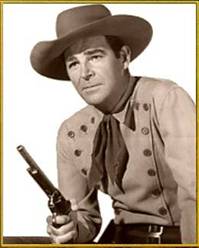
Rod Cameron
Rod started his movie career as a stunt man. That means he got tromped on, run-over, hit, smashed, and generally abused for a few dollars, while the more prominent movie folks stood in the wings and said, “Wow! My fans will think I’m great when they see me doin’ that.” But eventually, he got a speaking part, not in a Western, but he got one. And the rest just sorta happened. Most of his films were Westerns. And most of his Westerns were B films. His most memorable Western, at least by title, was RIDE THE MAN DOWN. You can still catch it
occasionally on the Westerns Channel. But he was in lots more. He even did a TV Bonanza. In his career he appeared with Tex Ritter, Rory Calhoun, Fred McMurray and lots of other folks. Late in his career, Rod went modern and played cops in 3 different TV series. Rod died in 1983 in Gainesville, GA, current home of rootin’ tootin’ cowgirl, Mesquite Millie.
Now before you write Rod off as a “so what”, remember this. At 1 time, some significant movie personalities had comic books about their movie adventures. John Wayne did. So did …. Rod Cameron. Yep. There were 20 issues of ROD CAMERON WESTERNS. How ‘bout that?
Badlands Beck
THE WEST OF OUR IMAGINATION –
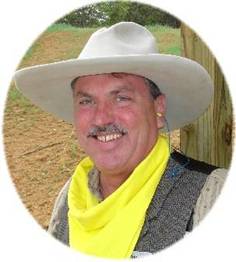
BADLANDS BECK
Some folks are influenced to do stuff by childhood chums. Take Badlands Beck for instance. He’s known Rawhide Rex since they were in the 6th grade. And ol’ Rex led him into Cowboy Shooting. Rex had been shooting sporting clays with Badlands, so it was 1 of them I’ll do your stuff, if you’ll do mine. And away they rode.
What’s Badlands shoot? “I started shooting .45 Vaqueros. Now, I shoot 2nd generation Colts. They’re .45’s too. And sometimes, I shoot S&W Schofields. They’re also .45’s.” When asked if he shoots mouse / butterfly loads, here’s what he said: “No. I shoot standard loads. I like to hear a good boom. I read what a guy said once. He said, ‘Why do I shoot .45 Colts? Because they don’t make .65 Colts.’ ” Badlands sounds like a real cowboy to me.
Here’s how he became Badlands Beck. “I really wanted Equalizer. When I was growing up, my dad said I was his equalizer. He said he couldn’t have stood the other 2 if it wasn’t for me. But someone already had Equalizer. My wife suggested Badlands Beck. Beck has always been my nickname.”
Badlands is an Outlaw shooter. “The 1st time I shot Outlaw was in Cleveland. Tombstone had been shooting it about 6 months, and I was tired of Traditional. I’d shot Duelist a little, and so, I tried Outlaw and loved it. I shot Traditional 1 time after that and hated it. Of course you have to get used to missing a lot, when you shoot Outlaw.”
Badlands Beck sports about 7 cowboy hats. Cowboy hats + .45’s + real loads = a real fine cowboy. He’s real friendly too.
THE REAL WEST – TOM JEFFORDS ( 1832 – 1914)
Everybody who’s a Western movie fan knows the story of Tom Jeffords. Sorta. We all know that he became blood brother to Cochise, the Arizona Apache leader, and brought an end to hostilities in the area. How do we know? Because we watched BROKEN ARROW, the movie and the TV series. Here’s the real story, in a short flippant version.
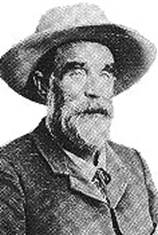
Thomas J. Jeffords was born in New York in 1832. Sometime before he arrived in the southwest, he operated some sort of small boat and became known as “Captain” Jeffords, and the name stuck: “Captain”. The Jeffords part wasn’t up for grabs. In 1862, he arrived in Arizona, and in the ensuing years he became a U.S. Army Scout, Superintendent of a Mail Line, Indian Agent, Deputy Sheriff, and desert rat Miner.
“Captain” Tom Jeffords
In His Later Years
The movie told the basics of the story: Jeffords met Cochise alone, established a friendship, and stopped the raids against and death of his mail riders. While hostilities continued in the area, his mail folks were not bothered. Then in 1872, President Grant sent General O. O. Howard to stop the warfare in the Tucson area. And Howard, learning about Jefford’s friendship with Cochise, convinced him to introduce him to his friend. Ultimately, a peace treaty was signed. In the process, Cochise sought and received approval for 2 things: (1) his (not all) Apaches were to be allowed to stay in their mountains and (2) Jeffords was to become their Agent. (Jeffords wasn’t thrilled about that.)
The treaty and the peace lasted a little over a year. Cochise died. The local folk in the Tucson area didn’t care much for “Indian Lover” Jeffords, and they wrote stacks of letters to Washington and had him removed as Indian Agent. They also convinced the politicians in D.C. to move the Cochise Apaches to San Carlos Reservation. That broke the treaty. The main reason the Tucson folks wanted the changes was so they could go copper and silver hunting on the Indian land. They did. The Indians resumed hunting white folks, and the hostilities didn’t end until 1886 when Geronimo surrendered for the last time.
What became of Jeffords? Well, he did other things: drove a stagecoach, served as a deputy sheriff, and mostly became a hermit miner, making a living digging holes and getting copper and silver in small amounts. The Tucson folks, had shunned him because of his dealings with the Apaches, and because of that, he evidently discovered that he didn’t like them any better than they liked him. So, in his final years, he lived with his best and most reliable friend: himself. Tom died in 1914.
 Entries (RSS)