

Page 1
Volume 4, Issue No. 2 March 4, 2006
59 SHOOTERS BATTLED THE CLANG GANG AT THE MARCH 4TH SHOOT
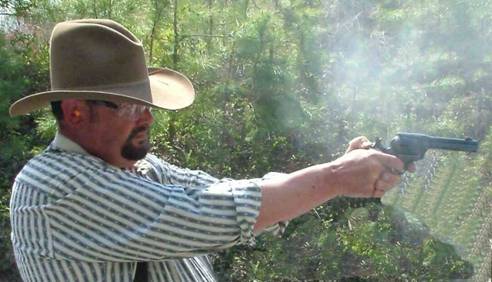
Festus D. Deputy was the Top Gun at the March 4 Shoot.
The absence of a February shoot didn’t lessen the shootin’ skills or desires to play the cowboy & cowgirl shootin’ game any, as demonstrated by the 59 shooters who gathered to battle the Clang Gang at the Leadmine Valley range. Before the main shoot began, Marshal Too Tall began the day by capturing 3 of the 4 pre-shoot side match events, commonly called “the Buffalo Shoot”. He won the .22 cal event and the 100-yard pistol shoot. And while he won the 100-yard lever action rifle shoot, he had real competition from Fast Harley. From sitting positions, both hit 5 targets with 5 shots. In the shoot-off, Too Tall hit 5 of 5 standing, and Fast Harley hit 3 of 5. Mad Mike won the 100-yard single shot event.
How’d the other shooting go? Well, once again Colonel Allison was 1 miss away from a clean match. Festus D. Deputy was the Top Gun, followed closely by Sunshine Billy and Dustin Clays. And Last Kiss was the top cowgirl shooter. Deadeye Drew was the only Jr. Shooter, so he placed first amongst the juniors. Unfortunately for both Deadeye Drew and T-Bone Angus, who shot B-Western, certificates are awarded only if 2 or more shooters participate in a category.
4 of the top 5 shooters shot no misses matches: Festus D. Deputy, Dustin Clays, Ocoee Red and Pleasant. Others who shot no miss matches were Purly, Barn Scoop, Limp Along Charlie and Awful Close.
Thanks to the set-up crew for having the range ready for the shoot. The crew consisted of Linc, Tucson Tuco, Sundance McNeyman and Horseshoe John.
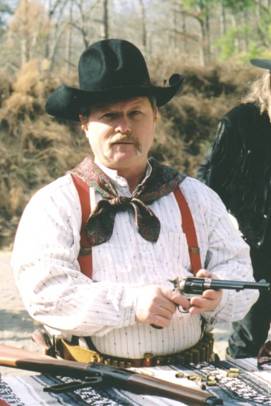
Marshal Too Tall – Side Match King
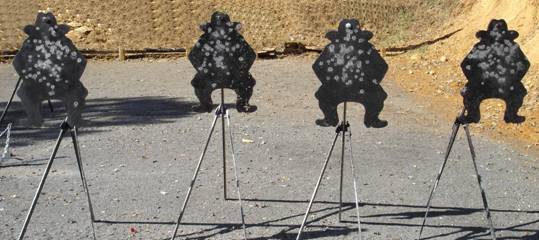
The Opposition – the Clang Gang
SHOOT RESULTS: Top Gun – Festus D. Deputy
Buffalo Shoot: .22 cal – Marshal Too Tall
Long Range Lever Action – Marshal Too Tall
Long Range Pistol – Marshal Too Tall
Long Range Single Shot – Mad Mike
|
Traditional 1. Dustin Clays 2. Whiskey River Nelson 3. Unpleasant |
Cowgirl 1. Last Kiss 2. Ms Dee Lightning Black Powder 1. Barn Scoop |
Senior 1. Sunshine Billy 2. Purly 3. Wildcat Wilkey |
|
49er 1. Festus D. Deputy 2. Ocoee Red 3. Marshal Too Tall |
Classic 1. Lightning McCoy 2. Bittercreek Jack |
Duelist 1. Tucson Tuco 2. Horseshoe John 3. Owlhoot Hardin |
|
Modern 1. Polecat Carl 2. Limp Along Charlie 3. Moonshine Roberts |
Outlaw 1. TN Tombstone 2. Rawhide Rex 3. Badlands Beck |
Gunfighter 1. Pleasant 2. Pyro 3. Keystone |
NEXT SHOOT – MARCH 25
The Buffalo Shoot begins 8:00 am. Registration 8:30 am – Posse Leader walk-through 9:15 am – Safety meeting 9:45 am – Shooting follows ! All times are Eastern Time.
Page 2
The Ocoee Ranger page 2 4 March 2006
THE REEL WEST, THE REAL WEST & THE WEST OF OUR IMAGINATION
THE REEL WEST – Don “Red” Barry 1910 or 1911 – 1980
In the heyday of Hollywood B Westerns, Don Barry was a silver screen cowboy hero. Don played a lot of different cowboys, including Red Ryder, a screen version of the comic strip character. From that role, he acquired a nickname that stuck for the rest of his life: “Red”. But he also played other western characters, including Jesse James. In addition to starring in his own films, he appeared with John Wayne, Roy Rogers and a whole posse of other name – recognized cowboys.
Don’s career lasted 40 years, and during that time, he made a lot of Westerns, and a lot of other films and appeared on TV. He was convincing in all his various roles, whether good guy or villain. In his later years, he appeared in many “character” roles, many somewhat like those played by Dub Taylor. But this word scratcher remembers “Red” Barry as a young cocky, straight shootin’ hero, not the “character” actor.
Don committed suicide in 1980.
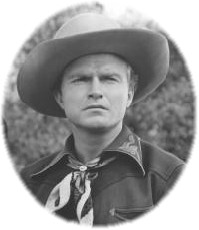
Don “Red” Barry
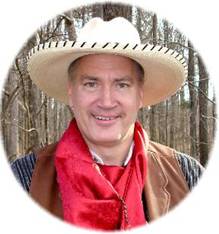
Tennessee Ted
THE WEST OF OUR IMAGINATION – Tennessee Ted
Once upon a time, Tennessee Ted was a Secret Service Agent, but he’s retired to the life of a dignified Cowboy Action Shooter. Why dignified? Here’s how he describes what he shoots. “I shoot .45’s. There’s only 1 cowboy caliber.” That’s dignity. Ted said he just dreamed up his alias, but Mesquite Millie commented, while I was writing this, that being from Tennessee and having Ted for a 1st name didn’t take too many slumbers or dreams to reach a conclusion.
How’d he get started in Cowboy Shootin’? Well, his brother-in-law shoots in GA and told him about Widow Maker, who was 1 of his shootin’ buddies. So, ol’ Ted called Widow Maker. They went to Knoxville, where he shot in his first shoot, and he was hooked. In his enthusiasm for his new hobby, he called his brother in Ohio and told him about it, and got him into hats and guns. And he got Slater, our Slater, under a Stetson and packing guns and shootin’ metal cowboys.
Who’s his favorite cowboy? Who else? John Wayne. With ever-present smile, a love of Cowboy Shooting, a fondness for John Wayne and an appreciation for .45’s, Tennessee Ted is a number 1 cowboy, who’s been shootin’ about 2 years.
THE REAL WEST – George A. Custer 1839 – 1876
George Custer was and continues to be 1 of the most controversial characters in Old West history. He was vain, and egotistical and arrogant, but so were generals Nelson Miles, George Patton, and Douglas McArthur. Custer was and still is criticized for his judgment and strategy at Little Big Horn. Many say he was foolish for splitting his command when attacking a superior force. But in the War of Northern Aggression, Robert E. Lee many times fought superior forces and won. And “Stone Wall” Jackson many times fought superior forces and won, such as his victory at Chancellorsville, where he split his command and attacked a superior force.
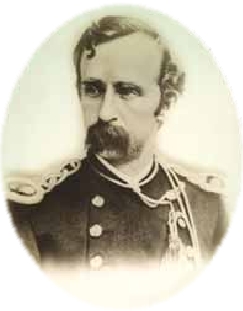
George A. Custer
Custer was born in Ohio in 1839. Not interested in farming, he managed an appointment to West Point, where he was an unspectacular student, graduating last in his class. He was commissioned a Cavalry Lieutenant in the War of Northern Aggression, and that began his legend. He became 1 of the best cavalry leaders in the Yankee army. Remember Gettysburg? Well, the day after Lee began his retreat, a major cavalry battle was fought near Gettysburg. Custer and his cavalry defeated the Confederate cavalry for the 1st defeat they experienced. Custer led from the front and his unit usually won the battles they participated in. As a result, he was quickly promoted to Brevet Brigadier General, and then Major General.
That war ended, the army shrunk and Custer became a Lieutenant Colonel, reassigned to the Western frontier. He became an Indian fighter. That means he was assigned to battle Indians, and he battled them. He grew older, but neither his vanity nor ego diminished. He was supremely confident of himself and his soldiers and gloried in his success.
In the summer of 1876, Custer embarked on his last campaign. In conjunction with General Terry and Colonels Gibbons and Crook, Custer was to help surround the Sioux and Cheyenne and either capture or attack them. Arriving at the valley of the Little Big Horn, he encountered his quarry, which outnumbered his troops. As he had in the War of Northern Aggression, Custer attacked the enemy. Splitting his command, he planned to attack from 3 directions, achieving surprise, confusion and victory. However, his old audacity and luck didn’t hold up. 1 arm of his command encountered stiff resistance and was halted in its attack, Reno’s command. The 2nd arm never engaged the enemy, Benteen’s command, but fell back and supported the unit that had fallen back in defeat. And Custer did what he’d always done. He attacked. But unlike his previous actions in which courage and luck and esprit de corps made him successful, he met a determined force defending themselves and their families. And he and the group that he led in the attack were all killed.
Was Custer a cartoon buffoon? General Sheridan didn’t judge him to be so. Was he an effective commander? He had been hugely successful in his career. Did he bite off more than he could chew at Little Big Horn? You bet. Does that mean that in the final analysis that he was incompetent? Well, the best predictor of what someone will do in the future is what he or she did or accomplished in the past. In his past, Custer had trusted himself and his soldiers and had charged and won against determined fighters. Did he misjudge his opponents at Little Big Horn, or misjudge himself and his forces? Evidently he did. That question has been debated since July 26, 1876. In any event, George Custer became immortal at Little Big Horn, and in controversy or glory, he’ll never completely die.
 Entries (RSS)